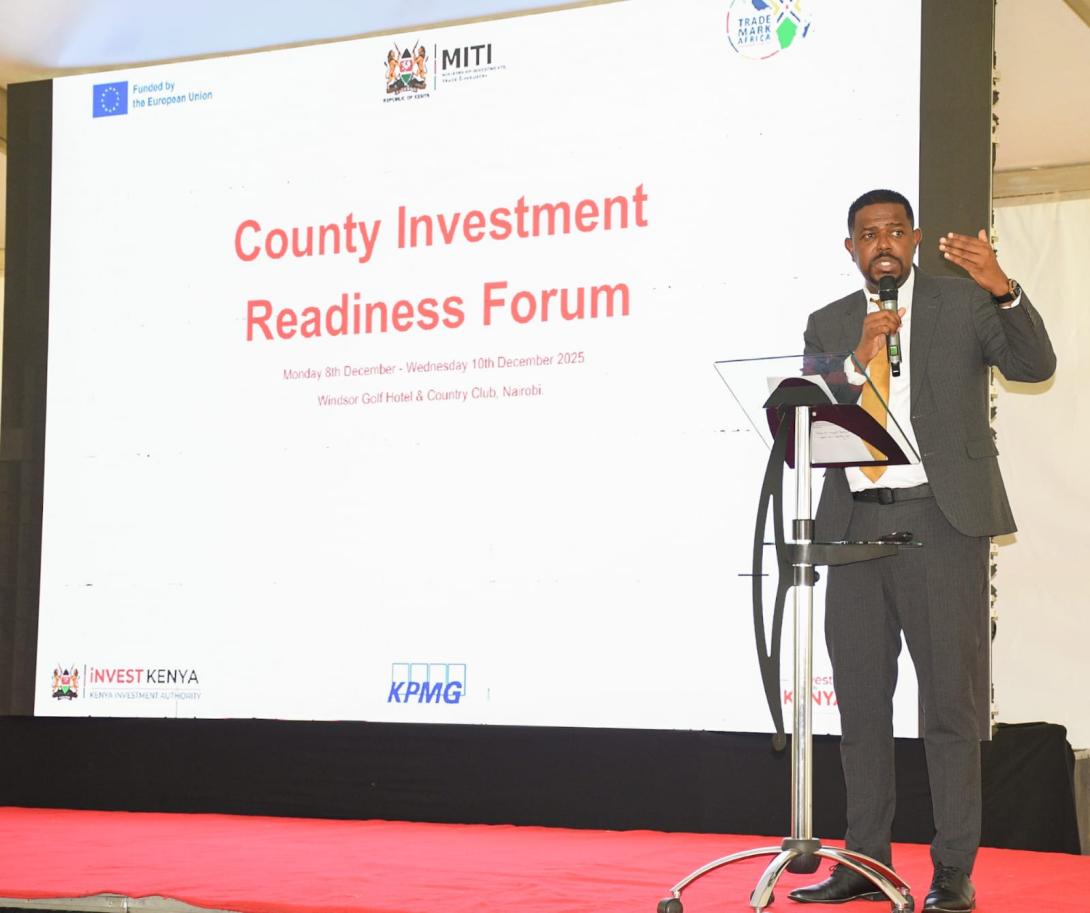
Kenya’s public and private sector leaders gathered in Nairobi for the County Investment Readiness Forum. A high-level meeting focused on evaluating the nation’s investment preparedness and boosting competitiveness at the county level. The event brought together national and county officials, development partners, investors and economic policy experts including Principal Secretary (PS) for Investment Promotion Abubakar Hassan Abubakar, Council of Governors CEO Mary Mwiti, Kenya Investment Authority CEO John Mwendwa and KPMG’s partner Smita Sanghrajka. The aim was to explore ways to streamline investor engagement, improve data accuracy and speed up the rollout of investment projects across all 47 counties.
Discussions centered on Kenya’s current investment landscape, which recorded an estimated USD 1.5 billion in 2024, with pharmaceuticals and manufacturing emerging as leading contributors. Stakeholders reviewed the readiness of County Aggregation and Industrial Parks (KAIPs), Special Economic Zones (SEZ’s) and Export Processing ones (EPZ’s) expected to be fully prepared for investors by focusing on land surveys, title deeds, infrastructure development and the efficiency of investor facilitation systems.
PS Abubakar underscored the critical role of counties in shaping Kenya’s overall competitiveness. “Counties are the frontline drivers of Kenya’s investment competitiveness. Investors look at Kenya through county experiences such as how predictable approvals are, how transparent land processes feel and how reliably services are delivered,” he said. The PS emphasized the government’s commitment to harmonizing licensing systems, strengthening county investment legislation and integrating county investment units with the National One-Stop Centre to ensure that investors “encounter one seamless, coordinated Kenya.” He also stressed the need to end fragmentation within the private sector, explaining that the existence of more than 130 Business Membership Organizations (BMOs) dilutes policy coherence and reduces the effectiveness of engagement with government.
Expounding on this, PS Abubakar highlighted the significance of the proposed Draft Public–Private Sector Engagement Bill, which seeks to organize Kenya’s BMOs under a unified umbrella. The Bill aims to streamline dialogue between government and the private sector, eliminate duplication and ensure that private sector voices are coherent and representative. According to the PS, the legislation is not intended to undermine any association’s influence but to strengthen collective advocacy, improve policy coordination and create predictable structures through which businesses can meaningfully participate in national and county investment reforms. He noted that effective public-private engagement is essential to creating a competitive investment environment and ensuring that reforms translate into measurable outcomes on the ground.
Kenya Investment Authority CEO John Mwendwa presented an assessment of the country’s investment performance, “Our assessment shows strong activity in pharmaceuticals and manufacturing, alongside increased reinvestments from domestic investors,” he said. Mwendwa further explained the need for counties to prioritize a single value chain to create bankable projects, supported by clear documentation and consistent messaging. He introduced the concept of an investment deal funnel to demonstrate why some projects fail to progress from expression of interest to implementation, urging counties to strengthen operational readiness and reduce bottlenecks.
Council of Governors CEO Mary Mwiti emphasized the strategic role of county investment units in structuring and promoting opportunities. She called for the documentation and sharing of best practices to avoid duplication and improve the quality of investor facilitation. Mwiti also highlighted the advisory issued by the Council of Governors on onboarding private sector investors into county industrial parks, urging counties to apply harmonized procedures and ensure clarity in their engagement frameworks.
Throughout the forum, participants reaffirmed their commitment to enhancing Kenya’s investment framework by improving county-level planning, strengthening public–private coordination and amplifying investor readiness across the country. The discussions underscored the need for counties to develop clear investment roadmaps, adopt responsive investor engagement practices and ensure that their projects are managed through well-structured institutional arrangements. It was further noted that investment opportunities within Special Economic Zones must meet investment-grade standards and that county investment corporations should be effectively utilized as special purpose vehicles to support industrial park operations.
The County Investment Readiness Forum marks an important milestone in aligning national and county priorities toward making every county truly “investor ready.” By strengthening coordination, advancing legislative reforms and improving investor facilitation, Kenya aims to cement its position as a competitive and predictable destination for economic growth.