
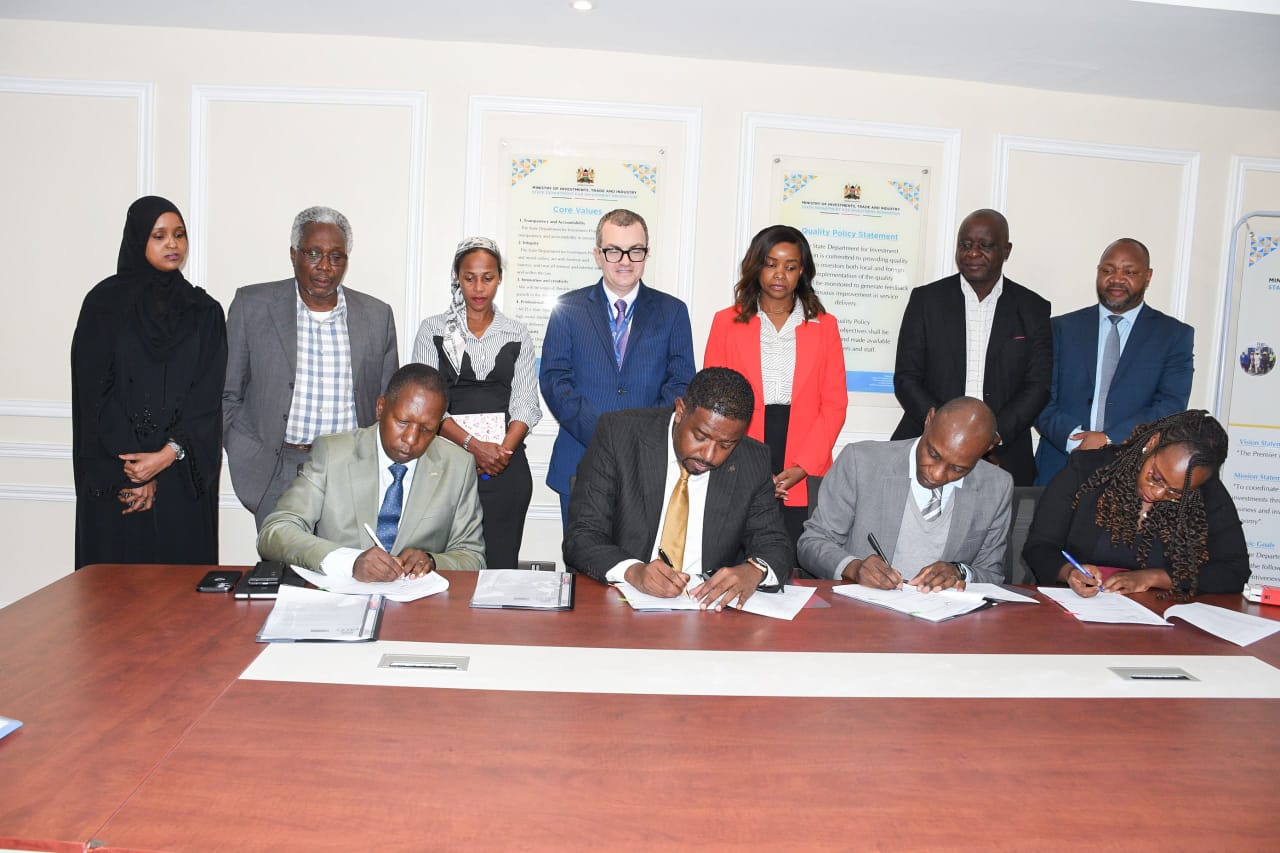
A US$200million Green Investment Fund Launched in Nairobi, Kenya
The government has contracted Britam as the general partner to the Multi-Million Green Investment Fund (GIF) expected to spur green investment in Kenya. Britam has formed a consortium with Wangara Green ventures of Ghana to mobilize more resources for the GIF.
GIFs blend public and private financing resources for climate mitigation, biodiversity, and sustainable development initiatives aligned with Environmental and Social Governance (ESG) principles.
Green investment funds channel capital into environmentally sustainable projects like renewable energy and climate adaptation. They aim to balance financial returns with positive ecological impacts, supporting global transitions to low-carbon economies.
Principal Secretary Abubakar Hassan Abubakar for the State Department for Investment Promotion signed on behalf of the government, while Mr. Barrack Ombatsa, CEO Asset Management on behalf of Britam
The Government through Kenya Development Corporation (KDC) has already staked $40million to operationize the GIF, while Britam is expected to mobilize the remaining $160million additional funds to up the GIF to $200million.
Mr Abubakar explained that the GIF is designed to mobilise finance for climate-smart, sustainable business growth in Kenya, while creating new jobs and strengthening economic resilience. It is part of the KJET Project’s push to scale green financing so that businesses can adopt technologies and practices that reduce environmental impact and strengthen competitiveness.
The Principal Secretary added that the signing of the contract with Britam addressed two of the GIF’s goals under KJET Project that attend to:
• Mobilising long-term capital meaning attract both public and private investment, including domestic institutional funds and international investors, into climate-aligned ventures; and
• Provide patient, risk-adjusted financing — through Kenya Development Corporation (KDC), make equity and quasi-equity (including mezzanine) finance available to small and medium enterprises (SMEs) that adopt green technologies and business models.
The other goals relate to:
• De-risking green investments, meaning use World Bank seed funding and blended finance tools that lower risk for private investors, thereby widening access to sustainable finance.
• Supporting priority sectors, meaning focus on areas such as clean and sustainable transport, energy-efficient construction, regenerative and climate-smart agriculture, and circular waste management.
• Align with Kenya’s climate and economic goals, meaning tie into national frameworks like the Green Economy Strategy and the Climate Change Act while driving job creation.
The beneficiaries span several groups, with effects both direct and indirect:
• Green and greening SMEs: Businesses adopting sustainable technologies or practices that would otherwise find it hard to secure long-term investment will be the direct recipients of GIF financing.
• Workers and communities: By strengthening SMEs, the project aims to create or improve jobs for tens of thousands of Kenyans (the KJET Project overall targets around 45,000 jobs, including at least 6,800 for women) through firm growth and competitiveness.
• Private investors and institutional partners; domestic pension funds, collective investment schemes, insurance companies, and international finance institutions benefit from new opportunities in green finance with structured risk mitigation.
• The broader economy and environment; strengthening sustainable sectors helps build climate resilience and contributes to Kenya’s transition to a low-carbon, inclusive economic model.
In essence, the GIF is both a financial instrument and a job-creation catalyst. Its success hinges on attracting sustainable finance into climate-aligned enterprises and helping them scale, a move that is anchored in broader goals of economic transformation and environmental stewardship under the KJET Project.